
The Unexpected Downfall of Derek H.: A Counterfeit Scheme Story
A Denver man bought 40 fake $100 bills for $1,200 in crypto, then fed them into ATMs until his bank froze the account.
- Written:
- Updated: October 26, 2026
- Editor: Cassandra Delacroix
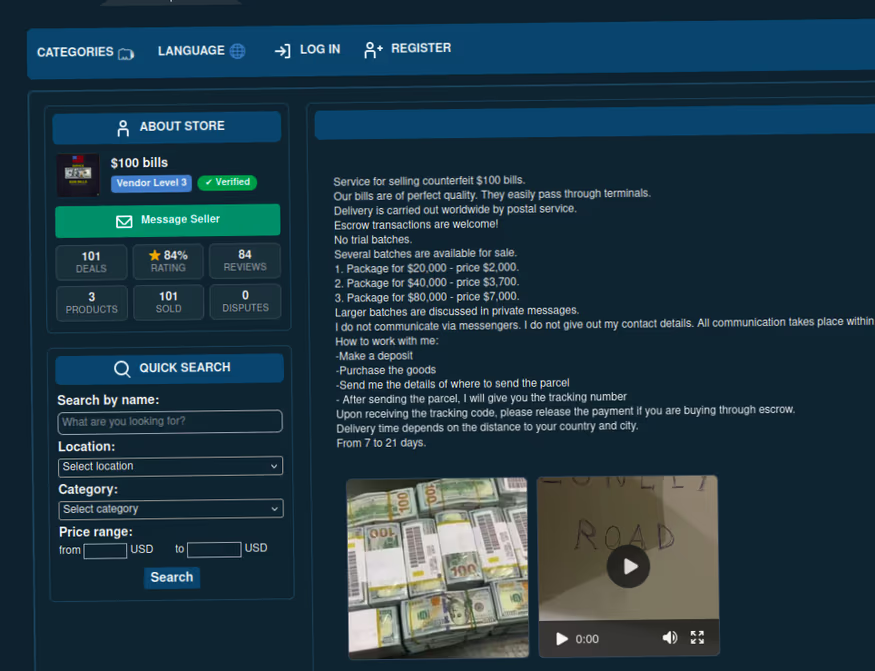
A site offering fake US currency with images of bills and purchase terms.
You might wonder how a dark web deal involving fake $100 notes resulted in a federal arrest so quickly. Let’s examine the essential elements of this situation.
Thinking he had come up with a clever scheme, a 29-year-old from Denver, Colorado, known as Derek H., made his move in January 2025. Derek H., a 29-year-old from Denver, spent $1,200 in cryptocurrency to obtain 40 counterfeit $100 bills from a vendor on the darknet. These fake notes were claimed to be from the 2009 series and featured elements designed to make them hard to detect as forgeries, including UV elements, magnetic strips, and watermarks, all marketed as being of "superdollar quality."
Derek's strategy was quite simple: he aimed to deposit these phony bills into ATMs that accepted cash deposits to boost his bank account balance. Initially, he succeeded with the first two machines, which credited him a total of $800. Complications occurred as one of the notes was rejected by the third ATM due to an error. Although the fourth machine accepted a bill, it flagged the transaction for additional scrutiny. Due to the questionable activity, his account was frozen by the bank by the next morning. Just three weeks after he made his first deposit, he found himself in custody of federal agents.
The source does not link the website where the purchase was made, but it describes a darknet marketplace listing with images of bills and purchase terms.
- Step 1: Buy fake dollars on a darknet marketplace
You kick off your journey by connecting with a seller who claims to provide high-quality fake currency. In January 2025, Derek stumbled upon a listing that showcased counterfeit bills, presented as authentic $100 notes. He invested $1,200 in cryptocurrency to secure 40 pieces from the 2009 series.
The table below summarizes key details from a reported purchase of counterfeit currency.
What was acquired Specifics Person behind the purchase Derek H., 29, Denver, Colorado Counterfeit $100 notes in the bundle 40 Amount sent in crypto $1,200 Year printed on the fake bills 2009 When the deal happened January 2025 What the seller promised "Superdollar quality" with UV, magnetic strip, watermark This deal took place on a covert darknet site, and a specific .onion link was not shared. If you search for counterfeit money online, you’ll find similar offers. Sellers frequently utilize phrases such as "100 dollar fake money" or "buy fake dollars". Derek's expenditure averaged $30 per bill, calculated by dividing the total cost of $1,200 by 40.
What does the seller mean by "superdollar quality"? The answer is straightforward: ATM and bank detection systems check for three key features—ultraviolet marks, magnetic ink, and watermarks. A bill failing to meet any of these criteria gets rejected, whereas one that qualifies can still be used in transactions.
- Step 2: Feed the fake 100 dollar notes into cash ATMs
You won't be handing cash to a teller; instead, you'll rely on machines. Derek began his experiment with two ATMs that accepted cash. Both machines took in the counterfeit $20 and $100 bills seamlessly, adding $800 to his account.
But then things changed. One ATM rejected a bill due to an error. The next ATM processed the deposit but marked it as "pending review."
This triggered the bank's fraud detection system. A rejected bill indicates that a sensor noticed something unusual, while a "pending review" status means the ATM physically accepted the note but flagged the transaction for further scrutiny. Consequently, the bank could freeze the account, hold the funds, or even file a Suspicious Activity Report.
If you're considering acquiring counterfeit $20 or $100 bills, be aware that ATM transactions can prompt investigations much faster than smaller in-store purchases. Depositing multiple large bills at different machines creates a clear trail that banks can follow.
- Step 3: Watch the account freeze and the Secret Service arrive
You may believe that your digital funds are secure, but that’s far from the truth. The day following the fourth ATM deposit, Derek found his account frozen by the bank. The $800 that had been credited was suddenly out of reach.
Approximately 21 days later, Derek was taken into custody by the U.S. Secret Service. While the specific charges weren't detailed, this agency specializes in cases involving counterfeit currency. The sequence of events is critical: a purchase in January, immediate ATM deposits, a freeze on his account within the same week, and his arrest occurring roughly three weeks later.
What led to this situation? There are three key missteps. Firstly, the bills Derek utilized didn’t qualify as genuine superdollars—at least one failed a detection test. Secondly, the ATM network flagged his unusual transaction patterns. Lastly, the bank connected the dots between the deposits and Derek’s account, opting to freeze it before he could access any of the credited funds.
If you look for realistic fake money online, you might come across items advertised for film or training purposes. However, the source emphasizes a darknet deal that offered counterfeit dollar bills purported to be suitable for bank transactions.
- Step 4: Compare the numbers from the source
A closer look at the money side of this case shows the buyer spent $1,200 in crypto to obtain 40 fake $100 notes. He initially got $800 out across two different machines, but the bank locked his account before he could touch the credited funds.
City and state: Denver, Colorado
How long before the account was frozen: next morning
Agency that made the arrest: U.S. Secret Service
Issue year on the notes: 2009
Total outlay: $1,200 in cryptocurrency
Amount credited before the freeze: $800
Face value per note: $100
Number of bills bought: 40
Cost per fake note: $30
Buyer's age: 29
How long before the arrest: 3 weeks
Machines that accepted the bills without a problem: 2
Machine that returned a bill: 1
Machine that flagged the deposit for review: 1
When you explore platforms that deal with counterfeit currency, you will often see prices listed per bill or in batches. In Derek's situation, he paid $30 for each bill. Regrettably, the seller's assurances regarding UV features, magnetic strips, and watermarks did not hold true across all machines.
What Derek's case shows
Derek's operation failed because the counterfeit bills were not flawless and the transaction history raised red flags. He used two ATMs to deposit $800 in fake $100 bills. However, one bill was rejected by the third ATM, and the fourth one raised concerns about the transaction. Consequently, the bank took action and froze the account the following morning. He was apprehended by the Secret Service three weeks after these events.
Details regarding Derek's previous criminal history remain undisclosed. The specific darknet site where he made his purchase is also not mentioned. The process is clear: acquire counterfeit dollars, deposit them at various ATMs, trigger scrutiny, lose access, and face arrest.
For those investigating counterfeit operations or listings for fake currency online, this case highlights significant failure rates. Just one subpar note out of a batch of 40 initiated the scrutiny process. Once the account was frozen, the $800 credit became irrelevant.
FAQ
How much did Derek pay for the fake 100 dollar bills?
He paid $1,200 in cryptocurrency for 40 counterfeit $100 bills of the 2009 series. That works out to $30 per note.
How much money did the ATMs credit before the freeze?
The first two ATMs accepted the bills and credited $800 to his account. The bank froze the account the next morning, so he never withdrew or transferred that balance.
Which agency arrested Derek?
The U.S. Secret Service arrested him three weeks after the deposits. The source does not list the specific charges.
What made the bank flag the deposits?
One ATM returned a bill with an error, and another flagged the transaction as pending review. The bank then froze the account and the Secret Service moved in.
Elsewhere on the site
How to Access the Dark Web Safely
Learn how to access the dark web safely with essential tools and best practices to protect your privacy and anonymity.
Tor URL: Accessing Hidden Resources Safely
Learn how to safely access Tor URLs and navigate hidden resources while avoiding common traps and verifying site authenticity.
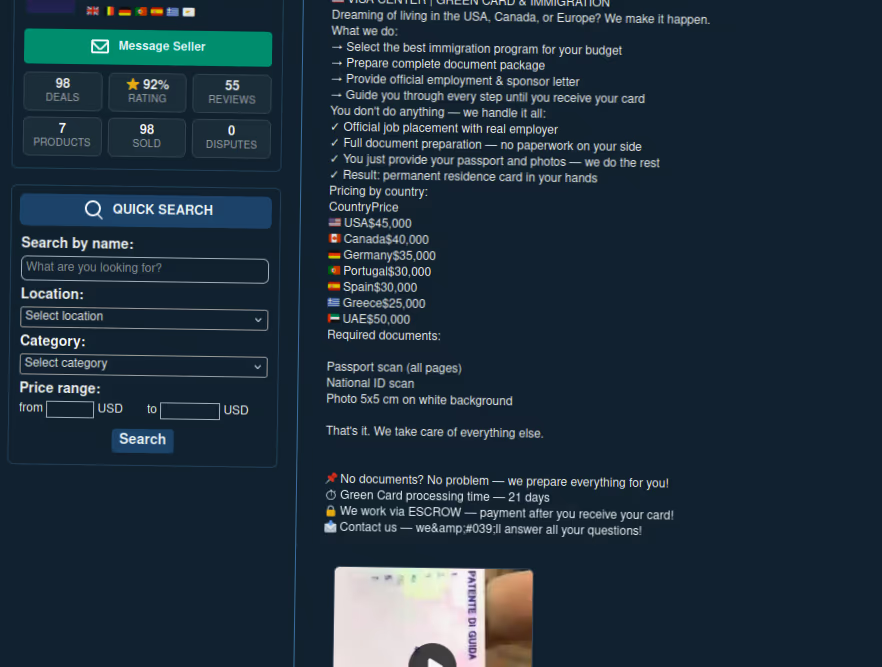
My Eye-Opening Experience with Dark Web Passport Scams
A registered passport starts at $30,000. Every $500–$2,000 darknet offer for a real passport or green card is a scam. Here's the full price…